Buying off-plan property in Kenya can secure a new villa at today's price, with a finish you choose. It also means paying a developer for something that does not yet exist. This checklist sets out what to verify about the land, the approvals, the developer and the contract, and how to structure payments so your money is protected as far as the law allows.
Key takeaways
- Kenya has no dedicated off-plan statute. Off-plan sales rely on general land and contract law, so the sale agreement matters more than anything else.
- There is no mandatory escrow for buyers' deposits in Kenya, so check exactly where your money goes and when it can be released.
- A bank holding a registered charge over the developer's land can rank ahead of buyers who have paid deposits, so always ask whether the land is charged.
- A new build usually needs county building approval, a NEMA environmental licence, and registration of the project with the National Construction Authority (NCA).
- Kenyan courts have ordered refunds where a project was abandoned, but a delay alone does not always justify one; the contract's long-stop date and refund clause decide much of it.
- Use your own advocate, not the developer's, and confirm each point for your purchase with them.
What does buying off-plan mean in Kenya?
Buying off-plan means signing a sale agreement and paying some or all of the price before the home is complete. Usually you pay a deposit, then further instalments as construction moves forward, with the balance on completion and transfer of title.
No single Kenyan law governs these sales. A review by the Centre for Affordable Housing Finance in Africa notes that off-plan disputes are decided under general contract law, and that courts have held developers to what they promised in brochures and adverts (CAHF, Annex G: Off-plan housing developments). The upshot is simple: your protection is what you check and what you write into the contract.
What are the main risks of buying off-plan in Kenya?
The risks are well documented in Kenyan courts and media:
- Stalled or abandoned projects. Business Daily reported in September 2026 on buyers losing money when projects stalled, including a case where a court ordered a full refund of KSh 41 million after a project was abandoned (Business Daily, 21 September 2026).
- No mandatory escrow. A January 2026 Business Daily column pointed out that Kenya has no mandatory escrow rule, so developers can collect deposits before construction starts (Business Daily, 8 January 2026).
- A bank ahead of you in the queue. If the developer has borrowed against the land, the lender may rank ahead of buyers, even those who have paid most of the price. CAHF cites court decisions where buyers who had not registered an interest or searched the title lost out.
- Insolvency. If a developer collapses, a buyer often has only a personal claim for money, not a secured interest in the property.
- Changes to the product. Plot sizes, layouts or finishes can change between the brochure and handover unless the contract fixes them.
What should you check before buying an off-plan villa?
Work through this checklist with your advocate before paying a deposit.
| Area | What to check | Document to ask for |
|---|---|---|
| Land ownership | The seller is the registered owner, and the title matches the site | Copy of title plus an official search |
| Charges and cautions | Whether a bank holds a charge, and if so, whether it has consented to the sale | Official search; lender's consent letter |
| Subdivision | Whether your plot has its own title yet, or will be created from a mother title | Approved subdivision scheme; individual title or timeline for it |
| Planning approval | The county has approved the building plans | County building approval |
| Environment | The project has an environmental impact assessment (EIA) licence where required | NEMA EIA licence |
| Construction | The contractor is registered with NCA, and the project is registered with NCA | NCA certificate; project registration certificate |
| Developer | Track record, completed projects you can visit, company registration | Company search; addresses of finished homes |
| Agent | Any estate agent involved is registered | Estate Agents Registration Board certificate and practising certificate |
| Specification | What exactly you are buying, measured and described | Floor plan, specification schedule, site plan |
A few of these deserve more detail.
Charges. Ask the developer directly whether the project is financed by a loan secured on the land. If it is, your advocate should obtain the lender's written consent to your purchase and confirm how your plot will be released from the charge on completion. CAHF's review highlights this as the step buyers most often miss.
Approvals. The National Environment Management Authority (NEMA) says projects listed in the Second Schedule of the Environmental Management and Co-ordination Act need an EIA licence before work begins. The National Construction Authority (NCA) requires construction projects to be registered, and the owner must apply within 30 days of awarding the contract to a registered contractor. Our sister site explains how to check that a contractor is NCA registered.
Agents. The Estate Agents Registration Board publishes a list of registered agents and advises buyers to ask for an agent's registration and annual practising certificates (The Standard).
Due diligence on the land. For a full walk-through of title searches and site checks, see Buying Land in Kenya: The Due Diligence Checklist.
What should an off-plan sale agreement include?
The contract is your main protection. Business Daily's September 2026 report listed several terms buyers often wish they had insisted on. Make sure your agreement covers:
- A completion date and a long-stop date. The agreement should say what happens if the long-stop date passes, including your right to cancel.
- Refund terms. How much is refunded, within how many days, and whether interest is paid. A developer cannot impose a repayment plan or cancellation fee that the contract does not allow.
- A fixed specification. Plans, areas and finishes attached as schedules, with a process for any changes.
- The payment schedule. Each instalment linked to a stage you can verify.
- Title. Which title you will receive, when, and who pays the transfer costs.
- Defects. A period after handover during which the developer must fix defects.
- Charges. A promise that your plot will be transferred free of any bank charge.
Do not rely on the word "escrow" alone. As the same report notes, protection depends on who controls the funds, when they can be released, and what happens if the project fails.
How should payments be structured when buying off-plan?
The safest structures link each payment to visible progress, so you are never far ahead of the work on site. A typical milestone sequence might be: deposit on signing; instalments at foundations, walls, roof and finishes; and the balance on completion and transfer. The exact stages are a matter for negotiation.
Practical safeguards:
- Pay only to the account named in the agreement, and confirm the details by phone with your advocate before each transfer.
- Visit the site, or ask someone you trust to visit, before releasing each stage payment. Ask for dated photographs and progress reports.
- Keep every receipt and bank confirmation. You will need them for your records and, one day, for capital gains tax on a sale.
- Ask your advocate whether to register a caution against the title. Section 71 of the Land Registration Act, 2012 allows anyone claiming an interest in registered land to lodge a caution, which can stop inconsistent dealings while it stays on the register.
What happens if the developer is late or the project stalls?
It depends on the contract and on how serious the failure is. Business Daily summarised recent cases: in Abdalla & another v Sheheena Enterprises Limited (2025), the High Court found a fundamental breach and ordered a full refund with costs and interest; in Saad M Saad v Tudor Heights Limited (2023), the court rescinded the agreement and ordered a refund with damages. The same report cautions that a delay alone may not justify a refund. The breach must be serious, and remedies range from completion to rescission or damages.
Litigation is slow and costly, which is why the checks and contract terms above matter more than the hope of a court order later.
Is an off-plan villa different from an off-plan apartment?
Yes, mainly in the title you receive. Apartments and other units in a shared building are now held under the Sectional Properties Act, 2020. Owners hold a sectional title to their unit and share the common property through a management corporation. Long-term leases of 21 years or more that conferred ownership of units had to be converted to sectional titles.
A villa on its own plot is usually sold with an individual title for that plot. Ask early which form of title you will get, and when.
What other costs come with buying off-plan?
On completion you will usually pay stamp duty: 4% of value in gazetted towns and municipalities such as Diani, and 2% elsewhere. Add your advocate's fees, valuation and registration costs, and VAT where it applies. Our guide to buying property in Kenya as a foreigner explains these costs and the 99-year leasehold rule for non-citizens.
Faraji Marijani: a ready-made option in Galu
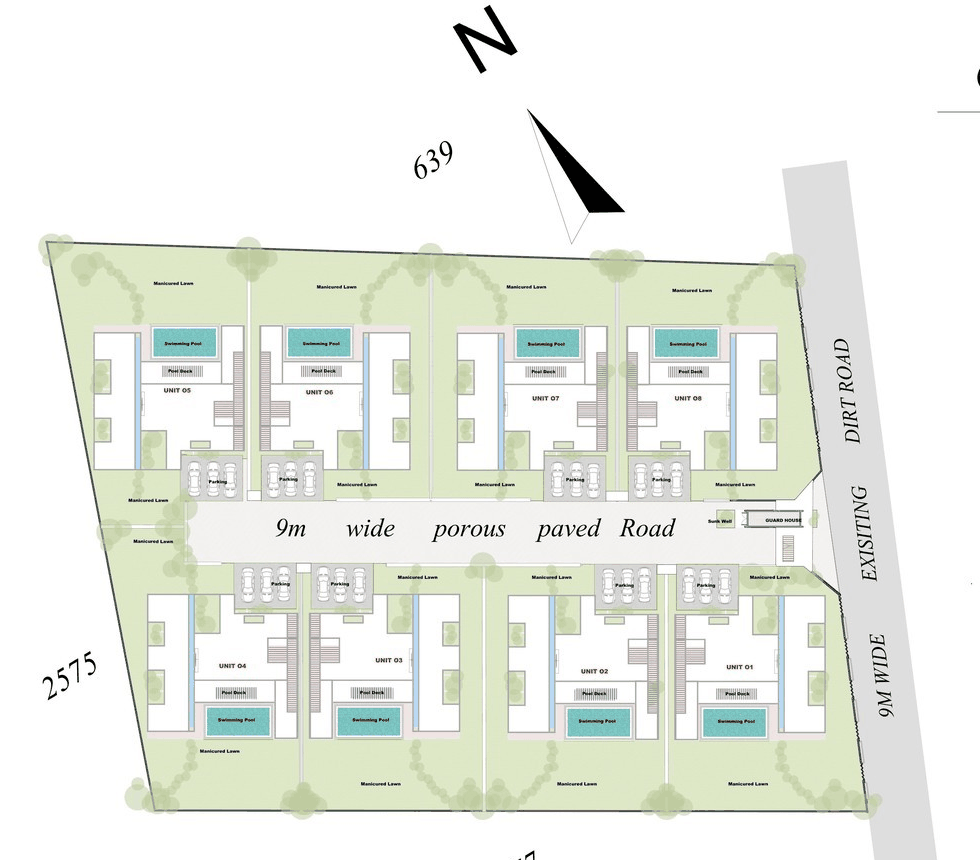
Faraji Marijani is a gated estate of eight private-pool villas in Galu, Diani Beach, Kwale County, developed by Msingi Engineering Group (Msingi). Msingi is registered with the National Construction Authority as a building works contractor and holds a current annual practising licence. Each villa sits on a titled quarter-acre plot (0.0940 ha) with its own private title. The estate has a gatehouse, boundary wall, paved estate road, storm-water drains, underground power and solar lighting. Buyers can pay cash, use bank financing, or make staged payments as the villa is built, within 24 months. The plot and villa package starts from KSh 29,550,000, excluding statutory fees and VAT where applicable; prices may change. Bring your advocate and your questions to a viewing: reserve a visit or see the Faraji Marijani guide.
Frequently asked questions
Is it safe to buy off-plan property in Kenya?
It can be, but Kenya has no specific off-plan law and no mandatory escrow for deposits, so the risk sits largely with the buyer. Reduce it by checking the title and any bank charge, confirming county, NEMA and NCA approvals, using your own advocate, and tying each payment to visible progress on site. Confirm every step with your advocate.
What is the biggest risk when buying off-plan in Kenya?
The developer failing to finish is the most common problem, and a related risk is a bank charge over the land. If the developer has borrowed against the property, the lender may rank ahead of buyers who have paid deposits. Ask whether the land is charged and get the lender's written consent to your purchase before you pay.
Can I get my deposit back if an off-plan project stalls?
Possibly. Kenyan courts have ordered full refunds with interest where a project was abandoned, as in a 2025 High Court case. But a delay alone may not justify a refund. Your rights depend mainly on the contract's completion date, long-stop date and refund clause, so make sure these are clear before you sign.
Should off-plan payments go into an escrow account?
Escrow can help, but it is not required by Kenyan law, and the word alone does not protect you. Check who controls the account, what conditions allow money to be released, and what happens if the project fails. Many buyers instead link each staged payment to a verified construction milestone and pay only to an account named in the agreement.
What approvals should an off-plan development in Kenya have?
Expect county approval of the building plans, an environmental impact assessment licence from NEMA where the project type requires one, and registration of the project with the National Construction Authority. The contractor should also be NCA-registered. Ask for copies and have your advocate check them, along with the title and any subdivision approval.
Can I register my interest in an off-plan plot?
Ask your advocate about lodging a caution. Section 71 of the Land Registration Act, 2012 lets a person who claims an interest in registered land lodge a caution with the land registrar, which can prevent inconsistent dealings while it remains. Whether it is appropriate depends on your agreement and the state of the title.
Sources
- Annex G: Off-plan housing developments (CAHF Kenya legal review)
- Kenyans lose money in off-plan development projects that never took off (Business Daily, September 2026)
- Kenya urgently needs escrow law to protect off-plan homebuyers (Business Daily, January 2026)
- Environment Impact Assessment (NEMA)
- Project Registration (National Construction Authority)
- Estate agents board warns against use of quacks as practitioners (The Standard)
- Land Registration Act, 2012 (Kenya Law)
- Section 71 of the Land Registration Act: Lodging of cautions (Sheriaplex)
- FAQs on sectional properties law in Kenya (DLA Piper Africa)
- The Ministry of Lands Raises Stamp Duty on Land Transfers (CMS Daly Inamdar)
See Faraji Marijani for yourself
Eight private-pool villas on titled quarter-acre plots in Galu, Diani. Plot and villa from KSh 29.55M.
Book a private viewing