Owning a villa in Diani is a pleasure, but the coast is hard on buildings and a home that stands empty for weeks needs looking after. Before you buy, it helps to understand the running costs of a villa in Kenya, who sets them, and how owners who live elsewhere manage upkeep. This guide sets out each cost, the rules behind it, and what changes if you let the villa to holidaymakers.
Key takeaways
- County governments set land rates on land and buildings under the National Rating Act, 2024, and can recover unpaid rates through penalties, charges on the property and, as a last resort, auction.
- Staff wages must meet the legal minimum set by Regulation of Wages orders; a 12% rise for general workers was gazetted in June 2026.
- Drilling and using a borehole in Kenya needs authorisation from the Water Resources Authority (WRA), and water use is covered by a permit.
- Short-term holiday lets must be licensed by the Tourism Regulatory Authority (TRA), and Airbnb withholds 5% of host earnings in Kenya for hosts with a KRA PIN, or 20% without one.
- Resident landlords pay Monthly Rental Income tax (MRI) of 7.5% on gross residential rent; non-resident landlords pay 30%.
- Confirm current rates, fees and tax treatment with Kwale County, KRA and a tax adviser before you budget.
What are the running costs of a villa in Kenya?
The table groups the main costs and shows who sets or controls each one. Exact amounts depend on the property, how often it is used, and the service levels you choose, so get current quotes rather than relying on averages.
| Cost | What drives it | Who sets or controls it |
|---|---|---|
| Land rates | County rate and the property's value on the valuation roll | Kwale County Government |
| Land rent | Applies to some leasehold titles granted by the state | National Government (Ministry of Lands) |
| Electricity | Usage: pool pump, air conditioning, water heating | Kenya Power tariffs |
| Water | Borehole pumping and treatment, or a utility connection | WRA permits; your own consumption |
| Staff | Caretaker, gardener, pool attendant, housekeeper, security | Minimum wage orders and employment law |
| Pool care | Chemicals, cleaning, pump and filter servicing | Your pool contractor |
| Garden | Watering, cutting, replanting | Your gardener |
| Repairs and repainting | Salt air, sun and humidity | Your maintenance plan |
| Insurance | Building, contents and liability cover | Your insurer |
| Estate shared costs | Gate, road, lighting and common services in a gated estate | The estate's management arrangement |
| Letting costs (if you rent out) | Manager's fee, cleaning, linen, licences, levies and tax | Your manager, TRA and KRA |
How do land rates work in Kwale County?
Land rates are an annual county charge on land and buildings. The National Rating Act, 2024 now sets one national framework for how counties value property and levy rates. A summary by Dentons Hamilton Harrison & Mathews explains that rates are set in the county's Finance Act each year, the Chief Government Valuer compiles valuation rolls, and owners can inspect the roll, object, and appeal to a National Rating Tribunal (Afriwise, March 2025).
Rates are payable on a date the county gazettes at least 60 days ahead, in one sum or instalments if the county allows. If rates go unpaid, the county can charge a penalty, sue, register a charge against the property and, ultimately, auction it. A petition challenging the auction powers was filed in the High Court in 2025.
For an absentee owner the practical message is simple: put land rates on a calendar, pay through official county channels, and keep the receipts. Proof that rates are paid up to date is commonly asked for when you sell or borrow against the property. Ask your advocate whether your title also attracts annual land rent.
What does it cost to employ staff for a villa?
A caretaker, gardener and pool attendant are the core team for many coastal villas, especially when the owner is away. Staff quarters (often called a DSQ, short for domestic servants' quarters) make a live-in caretaker possible.
Wages must meet the statutory minimum set by Regulation of Wages orders. In June 2026 the Ministry of Labour gazetted an order raising minimum wages for general workers by 12% (The Star, 5 June 2026). Minimum rates differ by job and by location, so check the current order for the Diani area and pay at least that amount. Employers also have duties under employment law, including written terms, leave, and statutory contributions. A local advocate or payroll adviser can set this up properly.
Many owners pay above the minimum for trusted staff who are effectively looking after a valuable asset alone for weeks at a time.
How do water and power work on the south coast?
Water. Many homes on the south coast rely on boreholes. The Nation explains that drilling needs a Water Resources Authority authorisation, that only WRA-licensed drillers may build boreholes, and that a water use permit, usually renewed every five years, governs how much may be drawn. If your estate has a shared borehole, ask who holds the permits, who maintains the pump, and how costs are shared. Budget for pump servicing, electricity to run it, and water testing or treatment where needed.
Power. A private pool's pump runs daily, and air conditioning, water heating and outdoor lighting add to the bill. Ways to keep electricity costs down include energy-efficient pumps and timers, solar water heating, and switching off non-essential circuits when the villa is empty. Ask whether the meter is prepaid or postpaid, and who will top it up while you are away.
What upkeep does a coastal villa need?
Coastal homes face salt-laden air, strong sun, high humidity and heavy seasonal rain. These speed up wear on metal, timber, paint and seals. A sensible maintenance plan covers:
- Pool: regular cleaning and water chemistry checks, plus pump and filter servicing.
- Metalwork: inspecting and treating gates, railings, hinges, light fittings and air-conditioning units for corrosion.
- Timber and decks: cleaning, sealing or oiling on a regular cycle.
- Roof and gutters: clearing gutters and drains before the rains, and checking for leaks after storms.
- Paint and render: touching up exterior paint before cracks let in moisture.
- Damp and ventilation: airing the house when unoccupied, and dealing with mould quickly.
- Garden: keeping vegetation clear of walls, roofs and drains.
- Security checks: testing locks, lights and alarms, and reviewing who holds keys.
Keep a logbook of every service and repair. It helps you spot recurring problems, supports insurance claims, and reassures a future buyer.
How do you manage a villa in Diani when you live elsewhere?
Owners who live in Nairobi or abroad typically choose one of three set-ups:
- A trusted caretaker on site, with a local contact or friend who checks in and handles payments.
- A property manager who arranges staff, maintenance, bills and inspections for a monthly or annual fee.
- A letting manager who also markets the villa, takes bookings and services guests, usually for a share of rental income.
Whichever you choose, agree in writing what is included, how money is handled, how often you get reports and photos, and what spending the manager can approve without asking. Make sure the manager understands your tax and licensing obligations.
What changes if you let the villa as a holiday home?
Letting brings extra costs and obligations:
- Licensing. The Tourism Act, 2011 and the TRA Regulations, 2014 require tourism accommodation, including villas and holiday cottages, to be licensed by the Tourism Regulatory Authority after an inspection. A January 2024 explainer listed an annual licence fee per unit of KSh 26,000 for villas and holiday cottages; check the current TRA schedule. In February 2024 the government directed all short-term rental operators to register with the TRA.
- Tourism levy. Business Daily reported in January 2026 that the Tourism Fund planned to extend its 2% levy to short-term rentals booked through platforms such as Airbnb from the end of June 2026 (Business Daily, 26 January 2026). Confirm whether and how it applies to you.
- Platform withholding. Airbnb withholds tax on Kenyan hosts' gross earnings: 5% if you provide a KRA PIN, and 20% if you do not.
- Rental income tax. KRA's eRITS portal describes MRI as a flat 7.5% of gross residential rent for resident landlords earning KSh 288,000 to KSh 15 million a year, with no expenses deductible, and a 30% rate on gross rent for non-resident landlords. How short-term holiday income should be taxed can depend on how the letting is organised, so take advice from a KRA-registered tax agent.
For the demand side, such as seasons, occupancy and what guests look for, see Is Diani a Good Property Investment? and the Galu Beach area guide.
How should you budget for running a villa?
Build your budget from the bottom up rather than from a rule of thumb:
- List fixed annual costs: land rates, any land rent, insurance, licences.
- Add monthly costs: staff wages and contributions, electricity, water, pool and garden supplies.
- Add a maintenance reserve for repainting, deck treatment, pump replacement and other periodic work.
- If you plan to let, add management fees, cleaning, linen, guest supplies, platform commissions, levies and tax.
- Review the budget after the first year using actual bills, and adjust.
Our guide to buying a holiday home in Diani covers the purchase side, and financing a holiday home in Kenya explains loan costs.
Faraji Marijani: a ready-made option in Galu
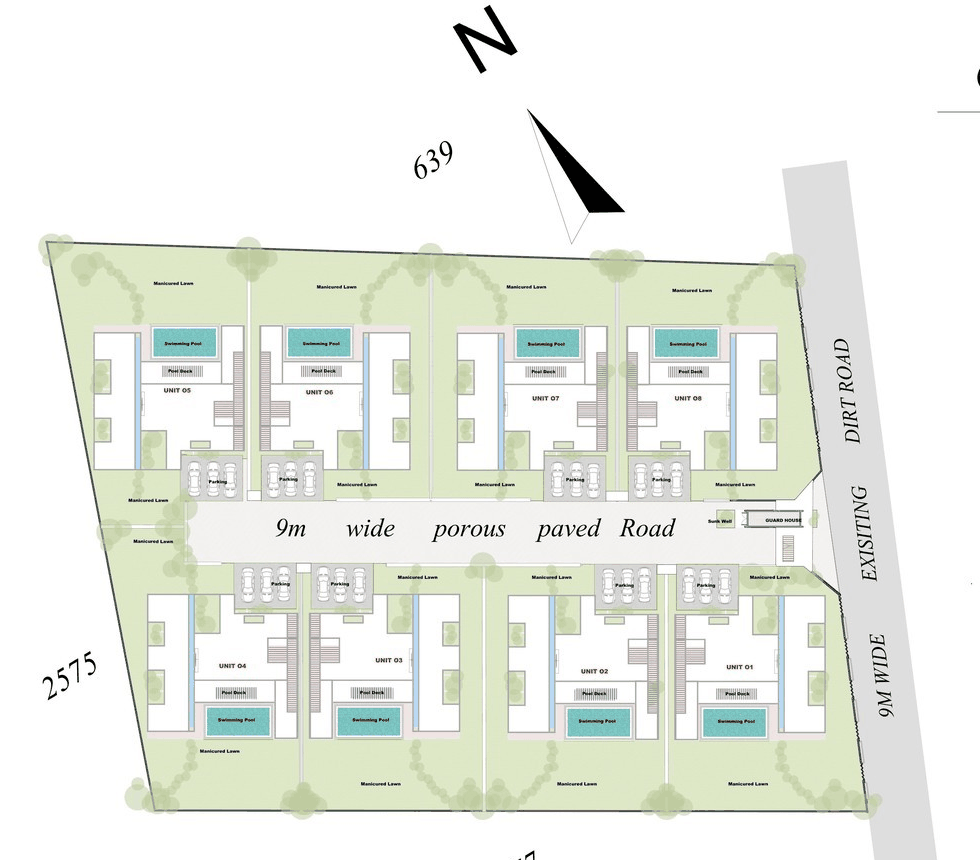
Faraji Marijani is a gated community of eight private-pool villas in Galu, Diani Beach, Kwale County, developed by Msingi Engineering Group (Msingi). The estate has a gatehouse and boundary wall, a paved estate road, storm-water drains, underground power, solar lighting and a shared or own borehole. Each single-level villa has three en-suite bedrooms, 214 m² inside, a 9 × 4 m private pool with an 80 m² deck, staff quarters (DSQ), a laundry, and a parking court for three cars. Each sits on a titled quarter-acre plot with its own private title. The plot and villa package starts from KSh 29,550,000, excluding statutory fees and VAT where applicable; prices may change. Ask about upkeep arrangements when you book a viewing.
Frequently asked questions
What are the main running costs of a villa in Diani?
The main costs are county land rates, electricity, water (often from a borehole), staff wages, pool and garden upkeep, repairs, and insurance. In a gated estate there may also be shared costs for the gate, road and lighting. If you let the villa, add a manager's fee, cleaning, tourism licensing, platform charges and rental income tax.
Who sets land rates for property in Diani?
Kwale County Government sets and collects land rates, under the framework of the National Rating Act, 2024. Rates are set each year in the county's Finance Act and based on the property's value in the valuation roll compiled by the Chief Government Valuer. Owners can inspect the roll and object. Unpaid rates can lead to penalties and, ultimately, recovery against the property.
Do I need a licence to rent my villa on Airbnb in Kenya?
Yes. Under the Tourism Act, 2011 and the Tourism Regulatory Authority Regulations, 2014, tourism accommodation, including villas and holiday cottages, must be licensed by the Tourism Regulatory Authority after an inspection. A 2024 government directive required all short-term rental operators to register with the TRA. Check current fees and requirements on the TRA's website before listing.
How much tax do I pay on holiday rental income in Kenya?
It depends on your status. KRA describes Monthly Rental Income tax as 7.5% of gross residential rent for resident landlords earning KSh 288,000 to KSh 15 million a year, and non-resident landlords pay 30% of gross rent. Airbnb also withholds 5% of earnings for hosts with a KRA PIN. Ask a tax agent which regime applies.
Do I need a permit for a borehole in Kenya?
Yes. Drilling a borehole needs authorisation from the Water Resources Authority, only WRA-licensed drillers may build it, and drawing water is governed by a water use permit that is usually renewed every five years. Drilling without authorisation is an offence. In a shared estate borehole, ask who holds the permits and how costs are divided.
How do I look after a holiday villa when I live abroad?
Most owners use a live-in caretaker, a property manager, or a letting manager who also handles guests. Agree in writing what is covered, how money is handled, and how often you receive reports and photographs. Keep a maintenance logbook, pay land rates and wages on schedule, and set a spending limit the manager can approve alone.
Sources
- National Rating Act, 2024 (Kenya Law)
- The National Rating Act 2024 (Afriwise / Dentons Hamilton Harrison & Mathews, March 2025)
- New rating law allows counties to auction land over unpaid rates (The Standard, October 2025)
- COTU welcomes new minimum wage increase, calls for enforcement (The Star, June 2026)
- Sinking a borehole? Here's what you need to know (Nation, April 2026)
- Explainer: How to register and operate a licensed Airbnb (The Star, January 2024)
- All short-term rentals to be registered in new directive (People Daily)
- Kenya expands 2pc tourism levy to Airbnb, Booking.com rentals (Business Daily, January 2026)
- Taxes on your earnings in Kenya (Airbnb Help Centre)
- eRITS FAQs — Monthly Rental Income (Kenya Revenue Authority)
See Faraji Marijani for yourself
Eight private-pool villas on titled quarter-acre plots in Galu, Diani. Plot and villa from KSh 29.55M.
Book a private viewing